Material Guide
Travertine vs. Marble Bathroom Sinks: Choosing the Right Natural Stone
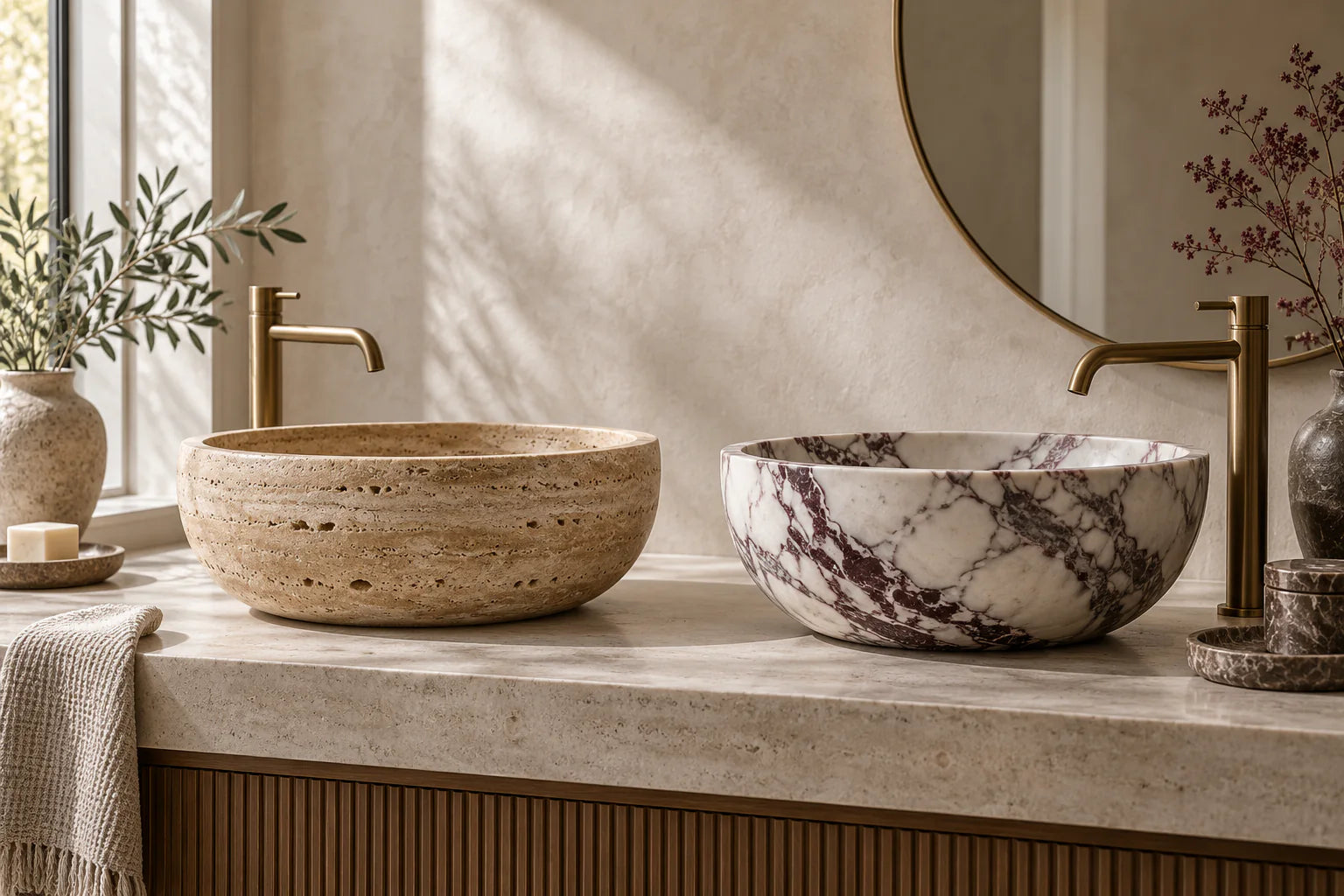
Travertine and marble can share a warm, mineral presence while producing very different rooms. Travertine reads through grain and earth tone; marble often leads with veining, contrast and movement.
The right choice begins with the atmosphere you want and the form of the sink—not with a claim that one natural stone is universally better.
01
Start with material character, not a winner
Travertine is a sedimentary limestone associated with mineral-spring deposits. Its linear movement, tonal layering and natural voids can create a relaxed, tactile surface.
Marble is a metamorphic stone. Depending on the variety, it can range from quiet cloudy movement to bold, high-contrast veining. Both are natural materials, so pattern and tone vary from one piece to the next.
02
Choose travertine for warmth and texture
Travertine sits naturally beside plaster, oak, limewash and aged metal. Honed and unfilled surfaces can emphasize its open grain; filled finishes create a more continuous touch while retaining the stone’s layered movement.
On a simple vessel or wall-mounted block, that texture becomes the detail. The material can feel calm in pale Troia tones or more grounded in walnut and red varieties.
Read the manufacturer's guide to travertine selection, care, and natural variation03
Choose marble for movement and contrast
Marble works when the sink should read as a singular statement. Calacatta Viola brings burgundy movement; Toros Black creates a dark architectural silhouette; Carrara offers a quieter light base.
The same marble can change significantly with geometry and finish. A curved vessel softens bold movement, while a rectangular wall-mounted form makes veining more graphic.
Explore Calacatta Viola across forms and finishes04
Let form and finish complete the choice
Vessel sinks expose the exterior profile and make material visible from several angles. Wall-mounted sinks add a front elevation, where a plain, fluted or ribbed face can change the entire expression.
A honed finish generally reads softer and more matte; a polished finish reflects more light. Finish affects appearance and care, so follow the product-specific guidance rather than assuming every stone behaves identically.
05
A practical material decision framework
Choose the room palette first, then compare the same general sink form in both materials. Review scale, edge profile, faucet relationship and the amount of visual variation you are comfortable accepting.
For any natural stone, use a pH-neutral cleaner intended for stone and follow the care information supplied for the specific product. Avoid acidic household cleaners. Sealing needs depend on the stone, finish and use; ask a qualified stone professional for the appropriate schedule.
- For a quiet, earthy room: begin with pale or walnut travertine.
- For strong movement or contrast: begin with expressive marble.
- For the clearest comparison: hold the sink form constant and change only the material.
- Before ordering: verify dimensions, finish, faucet arrangement and installation plan.
From the Luce Spaces catalog
A side-by-side material study
These active products hold the vessel format relatively constant so the material character remains easy to compare.

Light travertine
Troia Light Travertine Oval Vessel Sink
Warm, quiet tone and visible grain in a gently curved vessel profile.
View product
Dark travertine
Fontane Dark Walnut Travertine Vessel Sink
A deeper earth tone that emphasizes the layered character of travertine.
View product
Expressive marble
Calacatta Viola Marble Oval Vessel Sink
Burgundy and gray movement create a stronger focal point within the same sculptural category.
View productQuestions, answered
Frequently asked questions
- Is travertine or marble better for a bathroom sink?
- Neither is universally better. Choose according to the desired appearance, finish, care expectations and exact product specification.
- Does natural stone need sealing?
- Sealing needs depend on the material, finish and use. Follow product guidance and consult a qualified stone professional rather than applying a universal schedule.
- Can I expect the same veining shown online?
- No two natural-stone pieces are identical. Photographs show the material family and product design, while the delivered piece will have its own pattern and tone.